
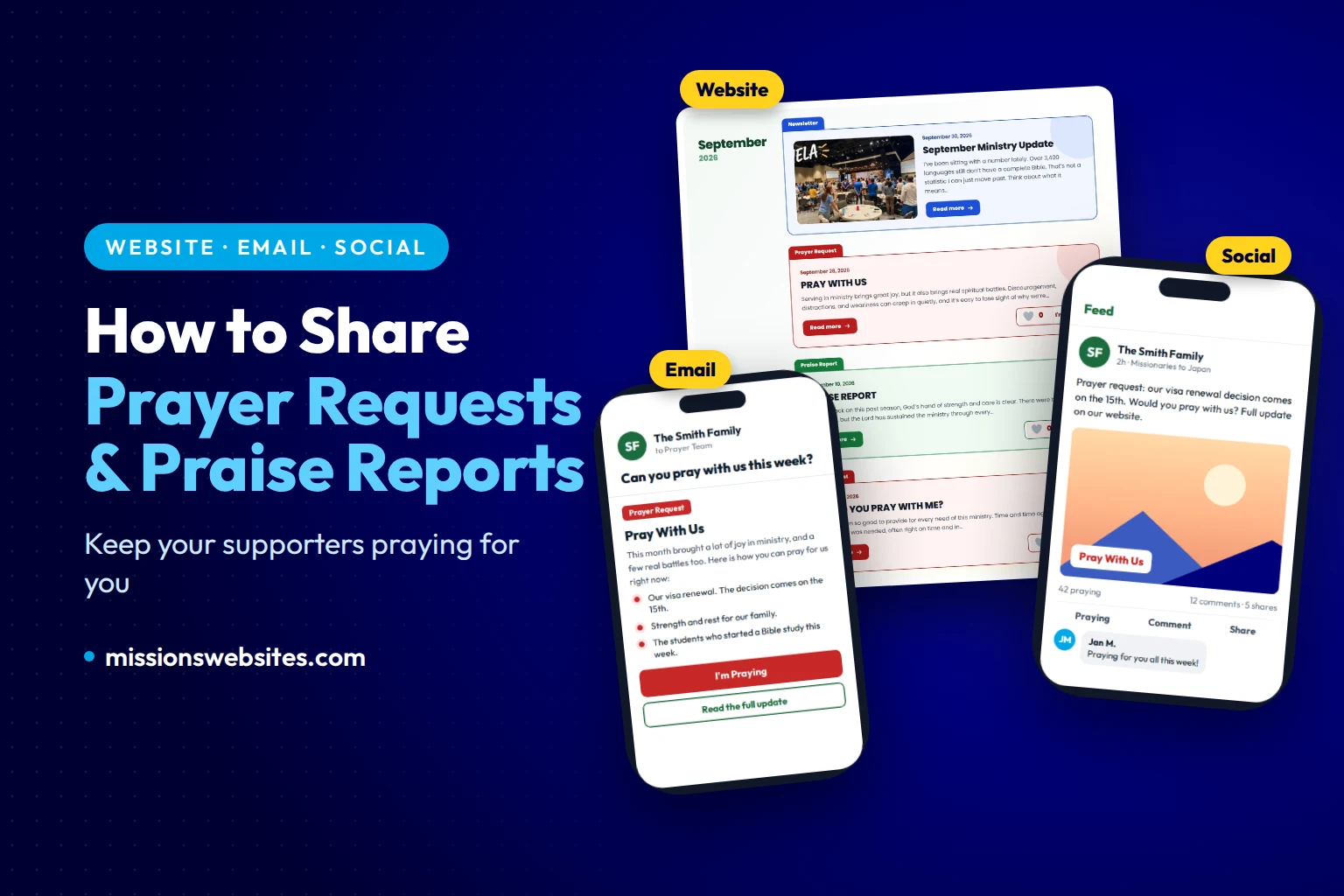
Your supporters want to pray for you. But they can only pray for what they know about, and they can only celebrate what God has done if you tell them.
That’s why prayer requests and praise reports are two of the most important things a missionary can share. A prayer request invites people into what you are facing right now. A praise report shows them how God answered. When you share both, supporters feel like they are part of your ministry, not just watching it from far away.
The tricky part is that your supporters aren’t all in one place. Some check their email every day. Some mostly see things on social media. Some will visit your website when they want to know what’s going on. In this post I will show you how to share prayer requests and praise reports on your website, by email, and on social media, with real examples, so you can reach all of them.
If you are looking for tips on what to write, check out our complete guide to sending missionary prayer requests.
Prayer Requests, Praise Reports, and Newsletters: What’s the Difference?
It helps to think of these as three different kinds of updates:
- A prayer request is short and specific. It tells people what to pray for right now, like a visa decision, a sick child, or a student who is asking questions about Jesus.
- A praise report shares how God answered prayer or something good He did. It’s the follow-up to a prayer request.
- A newsletter or prayer letter is your longer, regular update, usually monthly, with a story, photos, prayer requests, and praises all together.
Your monthly prayer letter is still important. But sharing short prayer requests and praise reports in between keeps people praying all month, not just on the day your letter arrives.
1. Sharing Prayer Requests and Praise Reports on Your Website
Your website is the home base for all of your updates. Everything you send by email or share on social media should point back to it, and anyone who visits can see what’s happening in your ministry right now.
Here’s a great example from Haley Kemp’s website, which we built for her ministry with the Fellowship of Christian Athletes (FCA) in north central Louisiana.
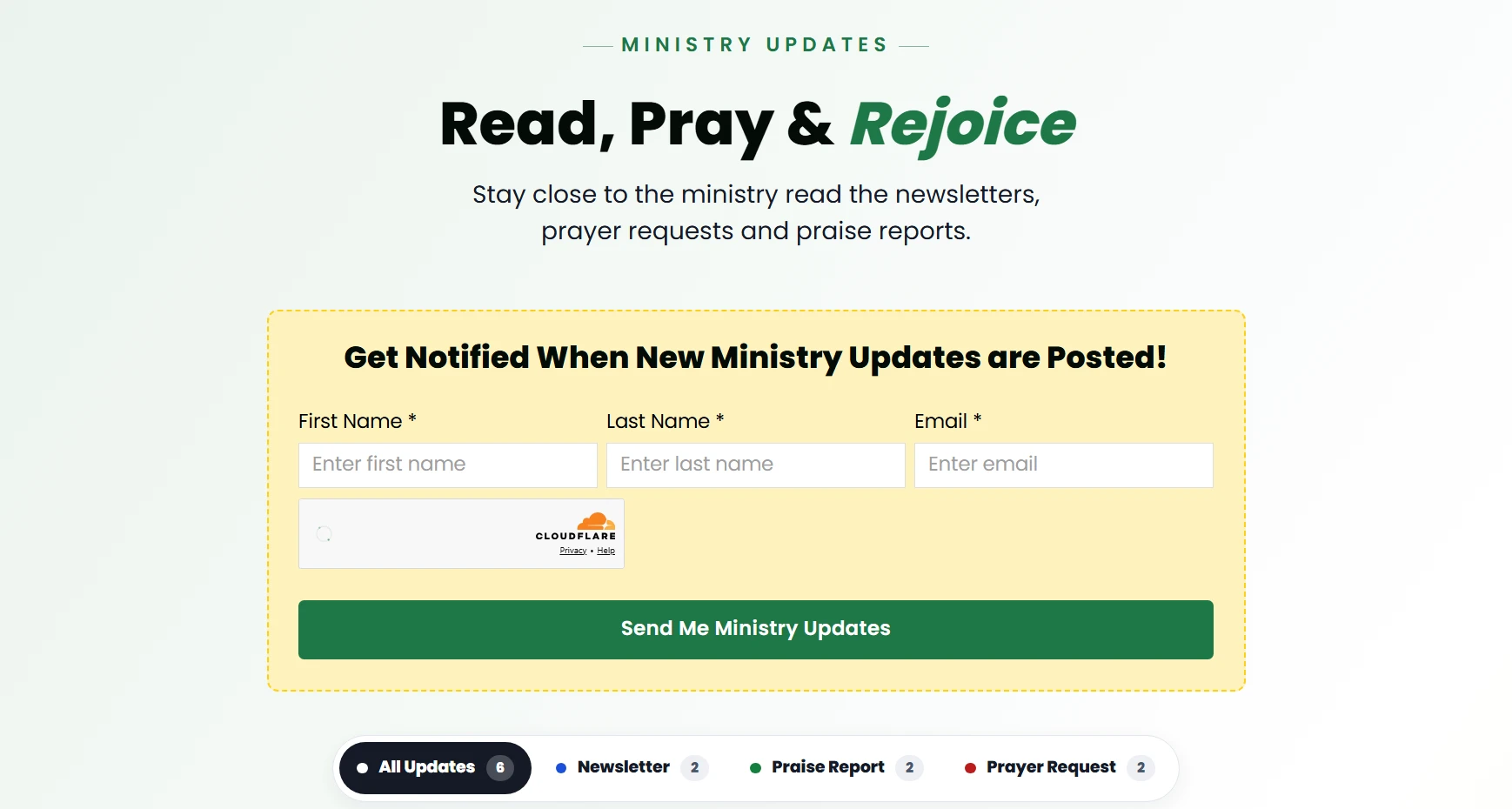
Her Ministry Updates page is called “Read, Pray and Rejoice,” which says exactly what the page is for. At the top, there’s a sign-up form so visitors can get notified whenever a new update is posted. Right under that are filter buttons so people can see all updates, or just newsletters, praise reports, or prayer requests.
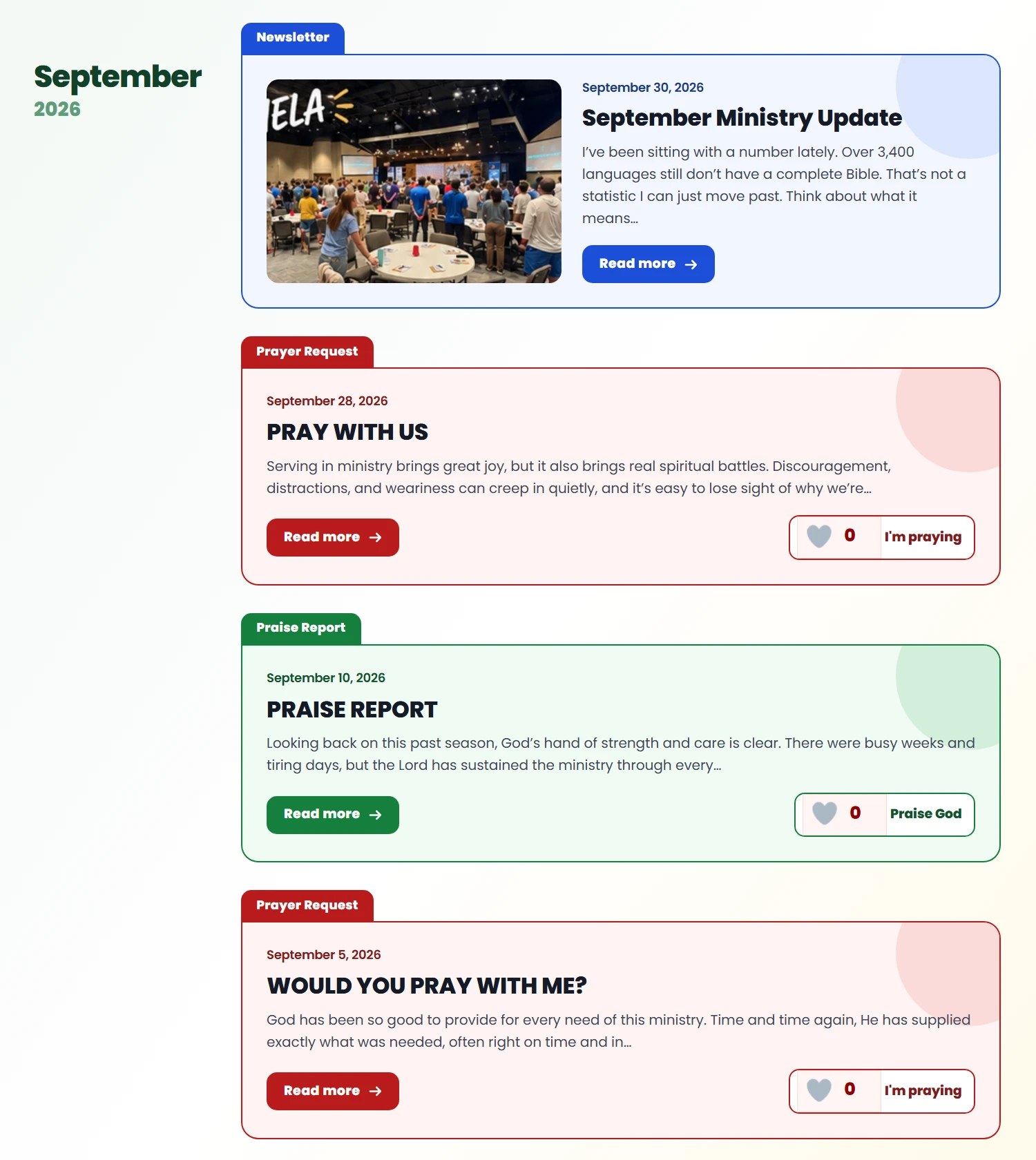
Below that, every update is organized by month. Each type has its own color and label, so it’s easy to tell them apart at a glance:
- Newsletters are blue
- Prayer requests are red
- Praise reports are green
The prayer requests have an “I’m praying” button, and the praise reports have a “Praise God” button. Supporters can click them to let Haley know they are praying or celebrating with her. It’s a simple way for people to respond without having to write a comment or an email, and it encourages Haley to see that people are praying.
What makes this work:
- Each kind of update is easy to recognize
- Supporters can filter to just what they want to see
- A one-click button lets people say “I’m praying”
- The sign-up form turns visitors into email subscribers
- Older updates stay organized by month, so new supporters can catch up on the whole story
You can see Haley’s website here.
2. Sending Prayer Requests and Praise Reports by Email
Email is still the most reliable way to reach most supporters, especially older supporters and church members. It shows up in their inbox and they don’t have to remember to check anything.
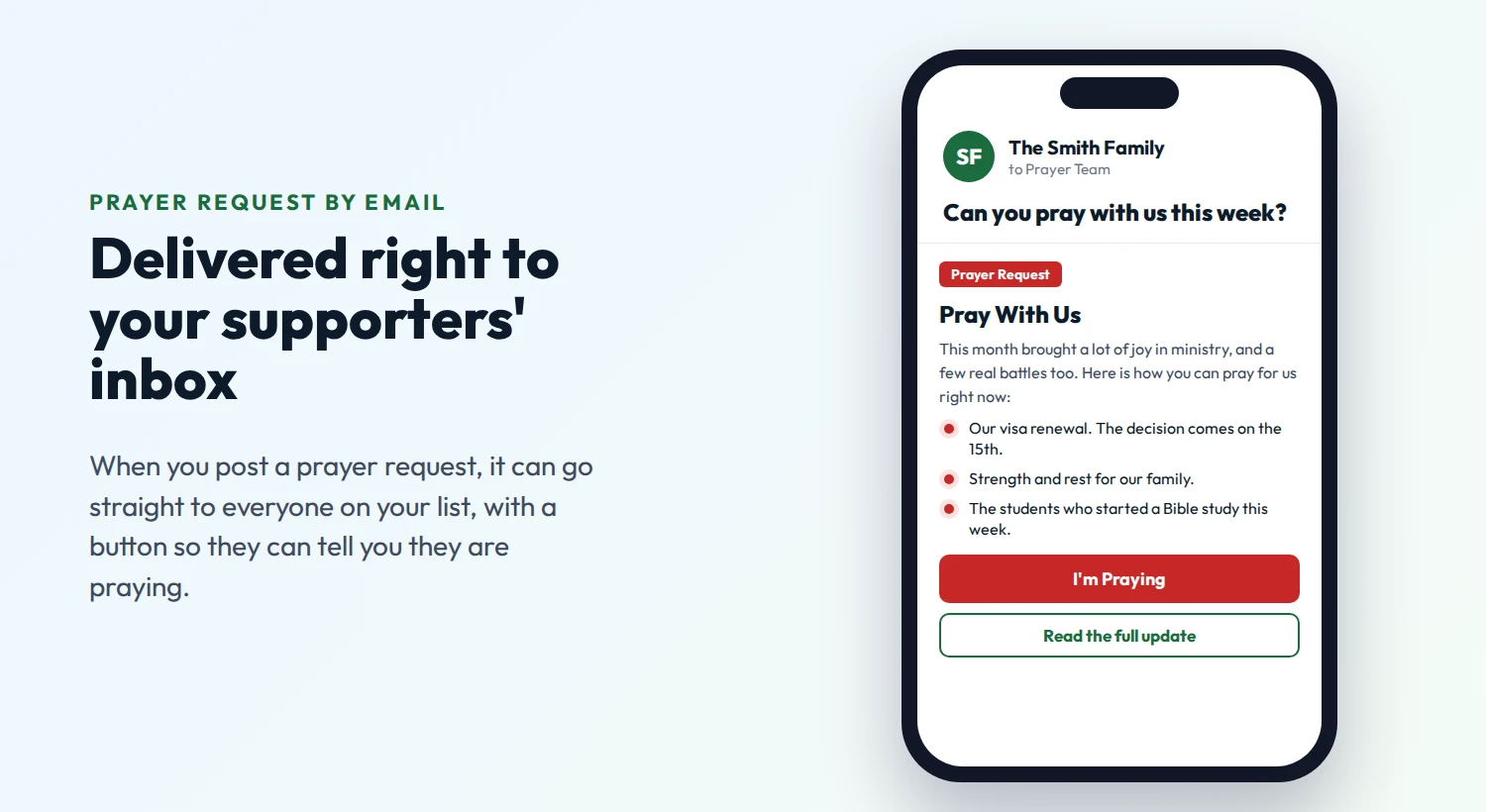
A good prayer request email is short. Here’s what to include:
- A clear subject line. Something like “Can you pray with us this week?” gets opened more than “Prayer Update #14.”
- Two to four specific requests. Names, dates, and details whenever it’s safe to share them.
- A way to respond. An “I’m praying” button or simply asking people to reply.
- A link to the full update on your website.
Praise report emails work the same way. Keep them short, say what God did, and thank people for praying. If it’s the answer to a prayer request you sent before, say that. Supporters love hearing that their prayers were answered.
How often should you email prayer requests? Your monthly prayer letter should include prayer requests and praises. In between, send a separate email only when something is urgent or when you have a praise report people will want to hear about. If you email too often, people start to skip them.
If you need help choosing an email tool, read our post on the best email software for missionaries.
3. Sharing Prayer Requests and Praise Reports on Social Media
A lot of your supporters, and their friends, spend time on social media every day. Sharing your prayer requests there helps you reach people who might not open your emails, and it makes it easy for people to share your request with others who will pray.
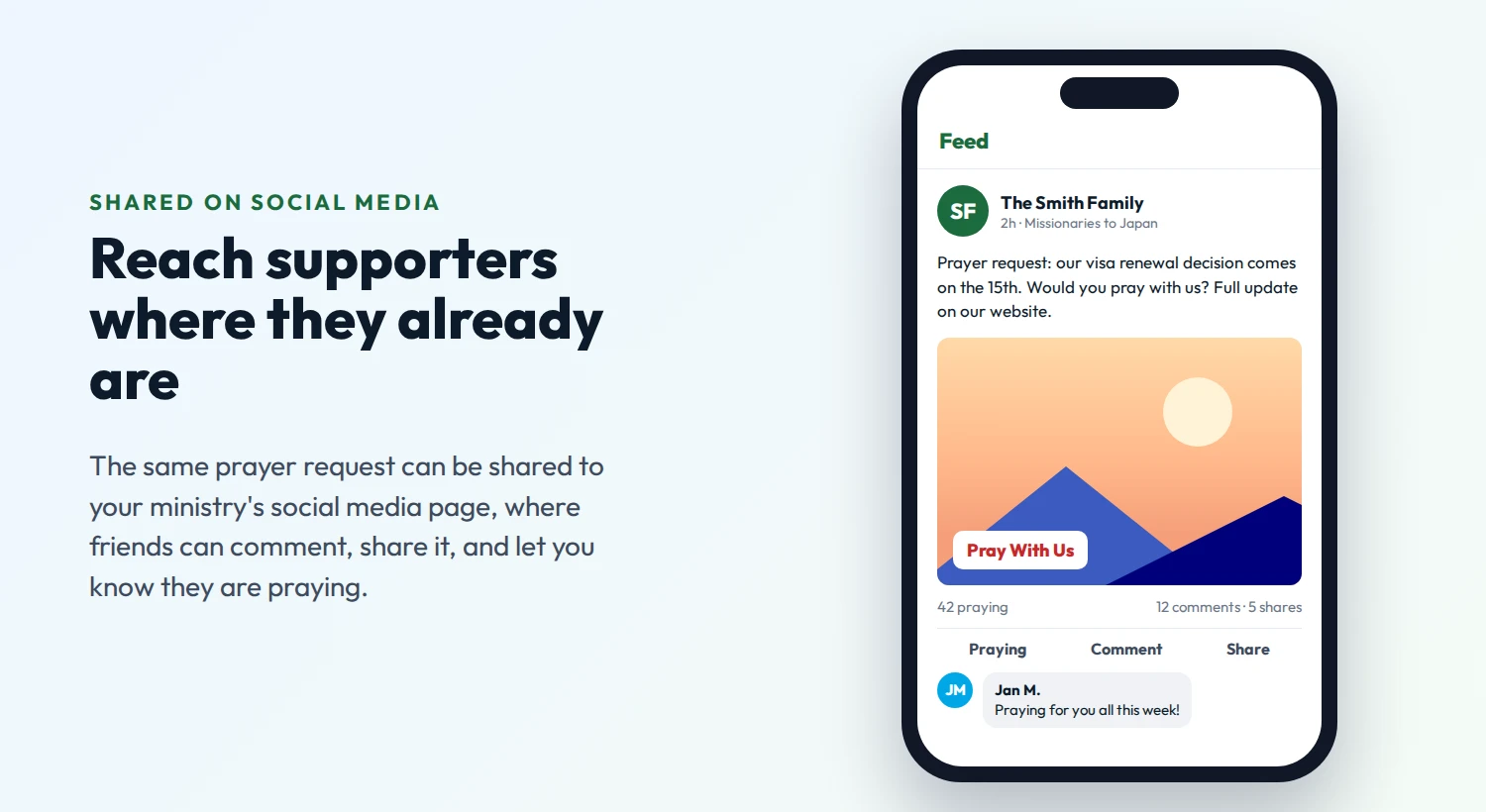
Here are some tips for social media:
- Keep it to one or two sentences. People scroll quickly.
- Add a photo. Posts with images get noticed much more.
- Link back to your website for the full update.
- Reply to comments. When someone says they are praying, a quick thank you means a lot.
- Share praise reports too. Good news gets shared, and it shows people that prayer matters.
Social media is a great way to spread the word, but don’t make it the only place you share. Not all of your supporters use it, and posts get buried quickly. Use it alongside your website and email.
If you serve in a sensitive country, be extra careful with social media. Posts can be shared and seen by people you don’t know. Don’t name local believers, show their faces, or share exact locations, and follow your mission agency’s guidelines.
Other Ways to Share Prayer Requests
Your website, email, and social media will reach most people, but there are a few other options that work well:
- A text or messaging group for a small, committed prayer team. This is great for urgent requests that need prayer today.
- Prayer apps like Prayvine, which are made specifically for sharing prayer requests with supporters.
- Your sending church. Ask if your requests can be shared in the bulletin, a prayer meeting, or the missions team email.
- Prayer cards with a QR code that links to your prayer requests page on your website.
- A short video. Sometimes a one minute video of you sharing a prayer request connects more than anything you could write.
Post Once, Share Everywhere
Sharing every prayer request in three or four places can feel like a lot of work. Writing it on your website, then copying it into an email, then posting it on social media takes time most missionaries don’t have.
That’s why we built Missions Websites the way we did. When you post a prayer request, praise report, or newsletter on your website, our system automatically emails it to your supporters and shares it to your social media. You write it once, and it goes everywhere. Supporters can respond with the “I’m praying” or “Praise God” buttons, and all your updates stay organized on your website, like Haley’s.
Always Close the Loop
One of the most important habits you can build is following up on your prayer requests. When God answers, share a praise report and connect it to the original request:
“Last month we asked you to pray for our visa renewal. It was approved! Thank you for praying with us.”
This does two things. It encourages your supporters by showing them that their prayers matter, and it makes them more likely to pray the next time you ask.
Examples of Prayer Requests and Praise Reports
Here are a few examples you can use as a starting point.
Prayer requests:
- “Our visa renewal decision comes on the 15th. Please pray for favor.”
- “Pray for the three students who started a Bible study this week.”
- “Our daughter has been sick for a week. Please pray for healing and rest for our family.”
- “We are $500 a month short of our support goal. Pray for new partners to join our team.”
Praise reports:
- “Our visa was approved! Thank you for praying.”
- “Two students gave their lives to Jesus at camp this week.”
- “God provided a car for our ministry through a generous gift.”
- “We are now fully funded. Thank you to everyone who prayed and gave!”
Tips for Sharing Prayer Requests and Praise Reports
- Be specific. “Pray for our ministry” is hard to pray for. “Pray for Kenji, who started reading the Bible this week” is easy.
- Keep it short. A prayer request can be two or three sentences.
- Be honest. Supporters want to pray for real struggles, not just good news.
- Protect people’s privacy. Ask permission before sharing someone else’s story, and be careful with names and photos.
- Update answered prayers. Mark them as answered or share a praise report.
- Be consistent. Regular updates keep people praying for you all month long.
Frequently Asked Questions
What is the difference between a prayer request and a praise report?
A prayer request asks supporters to pray for something specific you are facing. A praise report shares how God answered prayer or something good He did. Sharing both keeps supporters connected to your ministry.
Where should missionaries share prayer requests?
On your website, by email, and on social media. Your website keeps everything organized in one place, email reaches supporters reliably, and social media helps your requests get shared with more people.
How often should missionaries send prayer requests?
Include prayer requests in your monthly prayer letter, and send short updates in between only when something is urgent or important. Share praise reports whenever God answers.
Should I share prayer requests on social media if I serve in a sensitive country?
Be very careful. Don’t share names or photos of local believers or your exact location, and follow your mission agency’s security guidelines. In some cases, it’s better to share sensitive requests only with a private email list or prayer team.
How can supporters let me know they are praying?
You can ask people to reply to your email, comment on social media, or click an “I’m praying” button on your website. A one-click button makes it easy, and it’s an encouragement to see how many people are praying.
Can I share prayer requests on my website and email them automatically?
Yes. On the websites we build at Missions Websites, every prayer request and praise report you post is automatically emailed to your supporters and shared on social media. You can start with a $5 sample website to see what yours could look like.
Want a website that sends your prayer letters for you?
Post your update once. It gets emailed to your supporters and shared to Facebook and Instagram. We build it, host it and keep it running.
Get my $5 sample website