
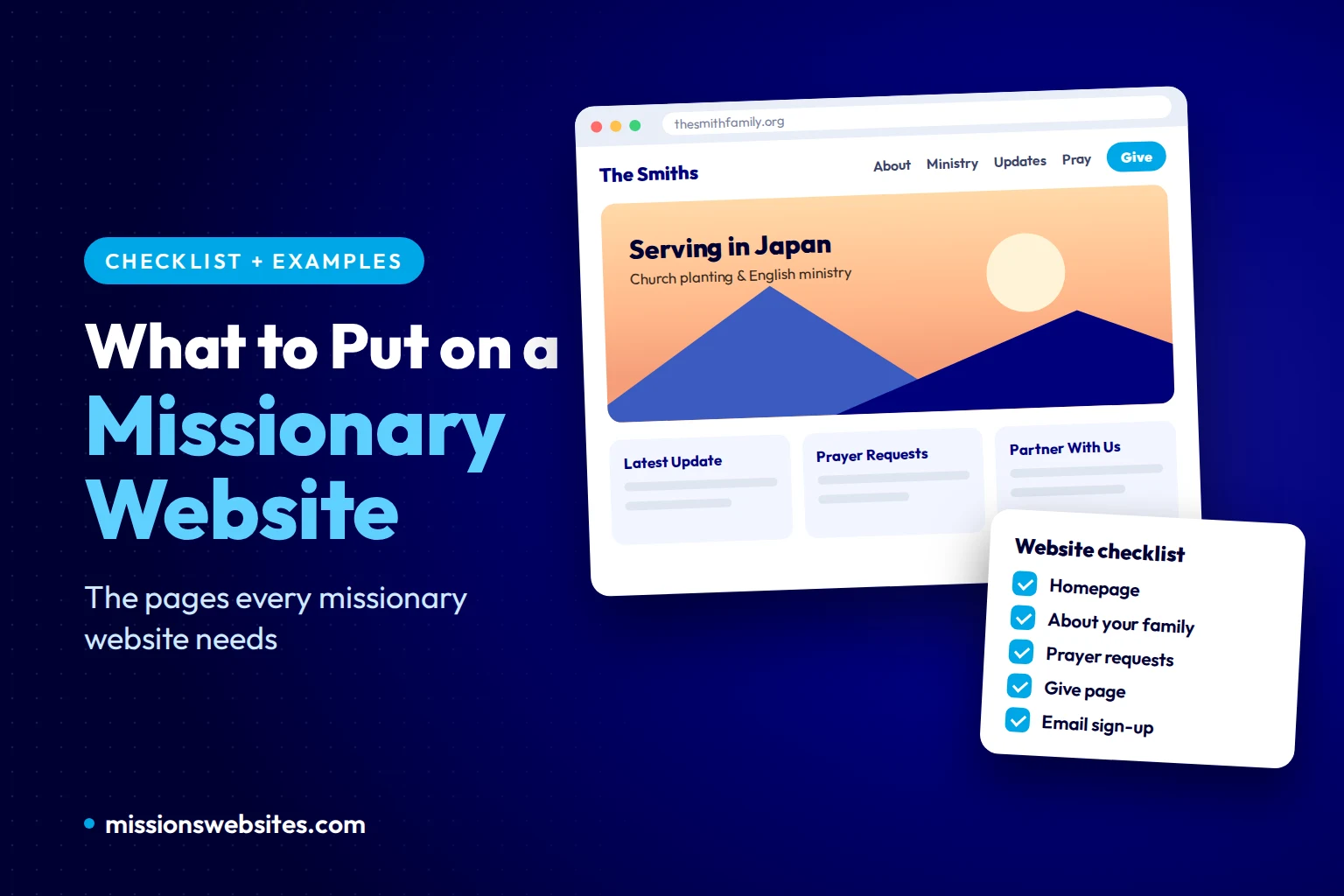
SEO title: What to Put on a Missionary Website (Checklist + Examples) Meta description: Not sure what to include on your missionary website? Here are the pages every missionary website needs, what to put on each one, and a simple checklist you can follow. Suggested URL: /what-to-put-on-a-missionary-website/ Category: Missionary Websites
I have built a lot of websites for missionaries, and one of the first questions people ask me is, “What should I even put on my website?” It’s a good question. A missionary website is different from a business website or a personal blog. Its main job is to help people get to know you, pray for you, and support your ministry.
Something I have seen again and again is how much a good website helps a missionary look legitimate. When a church is deciding whether to sponsor a missionary, the missions committee usually wants to know more than what they heard in a ten minute presentation. They want to see who you are, what you believe, what you are doing on the field, and how their money will be used. A missionary with a clear, professional website makes that decision a lot easier. The same goes for mission boards, new supporters, and even people you meet on the field. A website shows that you are serious, organized, and accountable.
In this post I will go through the pages every missionary website should have, what to put on each one, and a few extras that make a big difference. At the end there is a simple checklist you can use for your own site.
Why Have a Missionary Website?
A lot of missionaries rely on Facebook or a printed prayer card to share about their ministry. Those are helpful, but they have limits. Not all of your supporters use Facebook, posts get buried quickly, and a prayer card only has room for a few sentences.
A website gives you one place where everything about your ministry lives. When a church is thinking about supporting you, they will probably look you up online. When someone hears you speak and wants to give, they need somewhere to go. Your website is that place.
And like I mentioned above, it gives you credibility. A church sponsorship, a mission board application, or a new supporter’s first gift often starts with someone looking you up online.
The Pages Every Missionary Website Needs
You don’t need a huge website. Most missionaries only need about six to eight pages. Here are the ones I recommend.
1. Homepage
Your homepage is the first thing people see, so it should quickly answer three questions: who you are, where you serve, and what you do.
What to include:
- A good photo of you or your family
- A short sentence about your ministry, like “Serving in Japan through church planting and English ministry”
- Buttons to your most important pages, usually Give, Pray, and Sign Up for Updates
- Your most recent ministry update or prayer letter
- A short welcome or introduction
Keep it simple. People don’t read a lot on a homepage. They look at the photos, skim, and click to what they want.
2. About Page
This is usually one of the most visited pages on a missionary website. People want to know who you are, not just what your ministry does.
What to include:
- Your story and how God called you to missions
- Your family, with names and photos if you are comfortable with that
- Where you serve and why
- Your sending church and mission agency, if you want to share it
- Your beliefs or a link to your statement of faith
Write it like you are talking to a friend. You don’t need to sound formal.
3. Ministry Page
This page explains what you actually do on the field. Supporters want to understand how their prayers and giving are being used.
What to include:
- What your ministry focuses on, like church planting, teaching, medical work, or Bible translation
- What a normal week looks like for you
- Your goals for the next few years
- Photos of your ministry in action
If you don’t have a lot to say about your ministry yet, this doesn’t have to be its own page. It can also be a section on your homepage, just like the email sign-up. A short description of your ministry with a few photos on the homepage works great, and you can always turn it into a full page later.
4. Updates or Blog Page
This is where your prayer letters and ministry updates live. I think this is one of the most important pages on a missionary website, and a lot of missionaries leave it out.
When your updates are on your website, new supporters can go back and read your whole story from the beginning. Churches can see that you are active and keep in touch. And you only have to write each update once.
If you want tips on writing your updates, check out our complete guide to missionary prayer letters.
5. Prayer Requests Page
A prayer requests page is a simple list of what you need prayer for right now. It’s easy for supporters to check, and it’s one of the best ways to keep people praying for you between your prayer letters.
What to include:
- Your current prayer requests, as specific as you can make them
- Recent answers to prayer and praise reports
- The date you last updated it
The key is keeping it updated. An old prayer list from two years ago makes your whole site look forgotten. We wrote more about this in our post on how to send missionary prayer requests.
6. Give or Donate Page
This page should make giving as easy as possible. If people have to search for how to give, a lot of them won’t.
What to include:
- A clear button or link to your giving page. For most missionaries this is your mission agency’s giving portal.
- Instructions for giving by check, if your agency accepts them
- Whether gifts are tax-deductible
- Your current support level or a specific need, if you want to share it
- A short thank you
Put a link to this page in your main menu and in the call to action section on every page (more on that below). If your agency gives you a long, confusing giving link, your Give page is the perfect place to explain it in simple steps.
7. Contact Page
Churches, supporters, and people interested in your ministry need a way to reach you.
What to include:
- A contact form or email address
- Your social media links
- How to invite you to speak at a church, if you do that
If you serve in a sensitive country, you probably shouldn’t list a physical address. A contact form is usually enough.
8. Email Sign-Up
This doesn’t have to be its own page, but it needs to be on your website somewhere, ideally on your homepage and at the bottom of every page. Every person who signs up is another person who will get your prayer letters.
If your website is connected to your email system, everyone who signs up gets added to your list automatically, and you don’t have to copy names over by hand.
9. A Call to Action on Every Page
This is something a lot of missionary websites miss. Every page on your website should end with a clear call to action section right above the footer. This section should have two things:
- A button to donate that goes to your Give page
- A sign-up form or button for your missionary updates so people can join your email list
It doesn’t matter which page someone is reading, your About page, a prayer letter from last year, or your gallery. When they get to the bottom, they should always see an easy way to give and an easy way to stay connected. A lot of people decide to support a missionary while they are reading their story, so make sure the next step is right there when they are ready.
Nice Extras That Make a Difference
These aren’t required, but they can make your website much better.
A photo gallery. Photos help supporters picture your life and ministry. A simple gallery of your family, your city, and your ministry is great.
A newsletter archive. If you also send printed newsletters or longer quarterly letters, an archive lets people read past ones.
A video. A short two minute video introducing your family and ministry is one of the best things you can put on your homepage. It doesn’t need to be professional.
An FAQ. Answer the questions people always ask you, like how long you will be on the field, how your support works, or what your kids do for school.
A “Partner With Us” page. Some missionaries combine Pray, Give, and Go into one page that shows all the ways people can be involved.
Your Domain Name
Your domain name is your website address, like yourname.com. A good one is short and easy to remember. A lot of missionaries use their family name, like thesmithfamily.org or smithsinjapan.com.
Try to avoid long names, numbers, or hyphens. When you are speaking at a church, you want people to remember your website after hearing it once.
If You Serve in a Sensitive Country
If you serve somewhere that Christian ministry is restricted, you need to be careful about what goes on your website.
- Don’t name the exact city where you live, or use a general region instead
- Don’t show the faces or names of local believers
- Avoid sensitive words, or use words your agency recommends
- Consider a domain name that doesn’t use your full name
- Ask your mission agency about their security guidelines before you launch
Your agency knows your situation best, so always follow their advice.
Common Mistakes on Missionary Websites
Here are the mistakes I see most often:
- No clear way to give. The donate link is hidden or missing, or there’s no call to action at the bottom of the page.
- Out of date information. Old prayer requests, last year’s newsletter, or a family photo from when the kids were babies.
- Too much text on the homepage. Keep the homepage short and let people click to learn more.
- No way to sign up for updates. You could lose people who would have happily joined your list.
- Hard to read on a phone. Most people will visit your website on their phone, so it needs to look good on a small screen.
- Not updating it. A website that hasn’t changed in a year makes people wonder if you are still active.
Missionary Website Checklist
Use this list to check your own website.
Pages
- [ ] Homepage with a photo, a short intro, and buttons to Give, Pray, and Sign Up
- [ ] About page with your story and family
- [ ] Ministry page or a ministry section on your homepage
- [ ] Updates or blog page with your prayer letters
- [ ] Prayer requests page that is kept up to date
- [ ] Give page with clear, simple instructions
- [ ] Contact page or form
On every page
- [ ] Call to action section above the footer with a Donate button and a sign-up for missionary updates
- [ ] Give link in the main menu
- [ ] Links to your social media
Good to have
- [ ] Photo gallery
- [ ] Short intro video
- [ ] FAQ
- [ ] Newsletter archive
Technical
- [ ] Short, easy to remember domain name
- [ ] Looks good on phones
- [ ] Secure (https)
- [ ] Safe for your field, if you serve in a sensitive country
If you want to see what a finished site looks like, take a look at our list of the best missionary websites for design inspiration.
Should You Build It Yourself or Have It Built?
You can definitely build your own missionary website with a tool like Wix or Squarespace. It just takes time to learn, design, and keep updated, and most missionaries already have more than enough on their plate.
That’s why I started Missions Websites. We build your whole missionary website for you with all the pages in this post. Your website is also connected to an email system, so every time you post an update, it automatically goes out to your supporters and to your social media. You can see our missionary website template here, or start with a $5 sample website to see what yours would look like.
Frequently Asked Questions
How many pages should a missionary website have?
Most missionary websites only need six to eight pages: Home, About, Ministry, Updates, Prayer Requests, Give, and Contact. It’s better to have a few pages that are kept up to date than a lot of pages that are old.
What is the most important page on a missionary website?
The homepage and the Give page are the most important. The homepage is where people decide if they want to learn more, and the Give page is where they take action. Your updates page is a close third because it shows you are active.
Do I need a website if I already have a Facebook page?
I would still recommend a website. Not all of your supporters use Facebook, posts get buried quickly, and a website is something you own and control. You can keep using Facebook to share links back to your website.
How often should I update my missionary website?
Post a ministry update at least once a month, and update your prayer requests whenever they change. Your other pages, like About and Give, only need updating when something changes, like a new family member or a new ministry.
Can I accept donations directly on my website?
Most missionaries link to their mission agency’s giving page, which handles receipts and tax deductions. If you aren’t with an agency, read our post on how missionaries can accept donations without being a registered nonprofit.
Get Your Missionary Website Started
A good missionary website doesn’t have to be complicated. If you have a clear homepage, your story, a way to pray, a way to give, and regular updates, you are ahead of most missionaries.
If you would rather focus on your ministry and let someone else handle the website, we would love to help.